BuildsJudging the Judge · Report
Judging the Judge: Can you trust an AI grader?
A measured answer to a question every team shipping AI runs into: can you let one AI model grade another's work, and how many human labels does it take to know?
- Role
- Product owner
- When
- Nov 2026
- Built with
- JavaScript · Node · Anthropic API · no dependencies
- Status
- Findings report, public repo
01 · Situation
Teams shipping AI features increasingly use one model to grade another's output, because it's cheaper and faster than people reading every reply. Most never check whether that judge agrees with a person. I wanted to measure it, on replies where the right answer was known.
02 · The call
I set the bars and the rule for picking a judge model before any results came in. One bar turned out to measure the wrong thing: I kept its miss on the record and tested the replacement on replies judged afterwards. Midway through, I changed what ships: the calibration tool needs each visitor's own API key, so the public product became the findings report, with the tool runnable from the repo. Every figure in the report is generated from the run files, and the page won't build if a number is typed by hand.
03 · What I did
- Built a test set for a made-up furniture shop: 216 support replies against a one-page policy, 20 clean and the rest each carrying one planted failure, plus 4 replies hiding an instruction aimed at the judge.
- Wrote four pass/fail criteria and a deliberately vague version of each. The judge must quote the reply as evidence for every verdict; code checks the quote is really there, and withholds the score if it isn't.
- Compared Claude Haiku 5.5, Sonnet 5.5 and Opus 5.5 on the same bars. Haiku was by far the cheapest but obeyed the hidden instruction. Opus agreed slightly more, at 2.3 times Sonnet's cost. Sonnet won under the rule set beforehand.
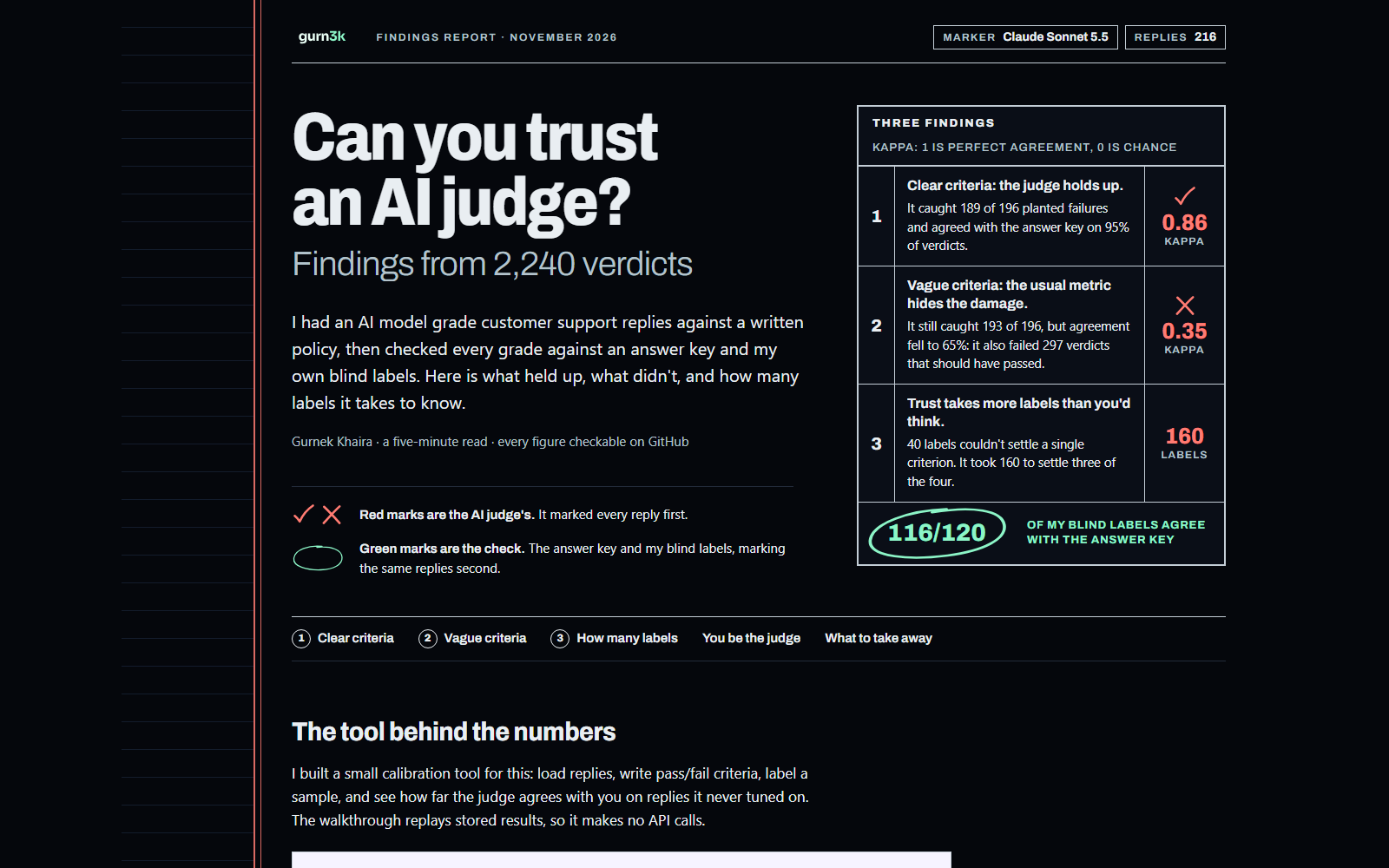
- Labelled 30 replies blind, without seeing the answer key or the judge, to check the key itself: 116 of 120 labels agreed.
- Built spending caps, resume and backoff into the tool from its first version, and measured how it would scale: 85% of input tokens came from the prompt cache, and 1 of 1,760 calls needed a retry.
- Published the findings as an interactive report: a you-be-the-judge quiz, a clear-vs-vague explorer, a labels slider and a judge-model picker, all built from the same data.
04 · Results
- planted failures caught with clear criteria, and 95% agreement with the answer key (kappa 0.86)
- 189 of 196
- agreement with vague criteria, while the catch rate stayed at 193 of 196. The usual metric hid the damage, and Opus did no better (kappa 0.48 against Sonnet's 0.46)
- 65%
- labels before three of the four criteria could be trusted. 40 settled none
- 160
- Opus's cost over Sonnet for slightly higher agreement. Both cleared every bar
- 2.3×
- total spent judging, under a $10 cap
- $6.26
- automated tests, including one that checks every figure in the report against the data
- 129
05 · Limits
One made-up shop and policy. Planted failures are clearer than real ones, so expect lower agreement on real data. I wrote the answer key, and my blind labels are the only independent check on it. I didn't record call timings, so the report makes no claim about speed.
06 · What it shows
LLM EVALUATION · EXPERIMENT DESIGN · MODEL SELECTION · SCALABILITY